on gilmore girls—why you find lorelai annoying
what it feels like to grow up with undiagnosed adhd (especially as a young girl)

— this was something i wrote in the fall of 2024 and then promptly felt too vulnerable to post. i’m posting it unchanged now because so many of the points still stand for me and because i hope that others will feel seen <3 so without further ado…
i’m always a little stunned by how often, when discussing gilmore girls even in the most passing manner, i hear that (although we all hated rory, for good reason1) lorelai was so annoying.
now, i get why you hate her. it’s very similar to the all-consuming frustration and self-loathing i feel staring in the mirror trying to persuade myself to see reason and act with some sense for once.
i discovered gilmore girls in the few weeks prior to a cross-country move mid-way through my university degree. for several years i had nursed the idea that the only way i could become a “real” writer was if i enrolled myself in a serious creative writing program. in high school i had coveted one such program at the university of british columbia, often daydreaming about the beaches and temperate weather of the west coast. however, unemployed teen that i was (and burden to already burdened parents), when there was no money to pay the fee required to apply to more universities, i made the tacit realization that living on campus in any capacity was likely out of the question. resolved to make the most of things, i promised myself that i’d stay home and go to the university downtown which was only (as my mother would say) an hour and half commute each way. it would allow me to save up, i told myself, and then in two years time, i’d follow my dreams and apply to transfer into ubc’s creative writing program.
flash forward to late 2017, i’m watching gilmore girls in my new dorm room where i’ve lived for a total of maybe three or four days—sobbing and crushed by the reality that the promised land that i had promised to myself was not going to save me. i had spent the previous two years seized by the worst writer’s block i had ever faced—the precocious girl who had written story after story in a fugue state and won award after award at graduation for her fiction and essay writing, was suddenly paralyzed with fear. in hindsight (and after a bipolar diagnosis in my mid-20s) those two years were the worst depressive episode i had had to date. in those days i truly did not want to be alive and i fantasized about killing myself multiple times a day. my inability to write—which previously was my only outlet to deal with my mental state—further indicated to me that i had lost all purpose. i was beyond the point of numb. i was simply catatonic.
thinking back now i’m not surprised that i was initially waitlisted for the program. i hadn’t written a thing i liked in years and the portfolio i submitted to the program was mediocre at best. but after that initial disappointment, i was accepted, and i began making plans for my new and promising future.
i had finally made it, hadn’t i?
i won’t get into the intense and manic summer i experienced before i left, but i will say those months certainly contributed to the dramatic dive my mental state took as the season came to a close. the girl who had been bragging about her upcoming move and incredible new life, was suddenly overcome with crippling anxiety.
i think by this point you can tell that i didn’t last long on the west coast. within a week of moving, a single creative writing class in, and several panic attacks later, i packed whatever i could into my suitcase, left the rest in the trash room of my dorm, and booked a last minute flight home to toronto the next evening. as i rolled up to the counter for residence services with my suitcase in tow, i appeased the stunned administrator by faking an emergency back home and quietly accepted when she declared that i wouldn’t get back my nine hundred dollar deposit for residence.
in the countless phone calls with my family that followed i told them that i didn’t like the people in my class and that i desperately missed home. i told them that i was leaving so soon because i wanted to be able to re-enrol in my old university and that i didn’t want this lapse in judgement to ruin my academic future. my parents bought that i truly missed them and my sisters found it near comical the way i barely lasted a week on my own. in the weeks after i returned home, i continuously apologized for not listening to advice that a cross-country move would be too much for me.
but the truth was, despite how unsettled i felt in that new place, i had ultimately succumbed to the voices in my head that said i was going to fail at writing—and at generally living life—just a badly as i had failed in those previous two years. and with the lingering dregs of a manic episode still upon me, the delusion that returning home would solve all my problems (much like the delusion of leaving home would do the same) settled itself firmly into my mind.
i remember being at the airport, calling my best friend at the time, and crying dramatically into the phone unable to articulate in any coherent way what i was going through. i sensed even back then that this friend was stunned by the call, but overwhelmingly the unsaid question that hung in the miles of air between us was “why are you like this?”
i have asked myself this question a thousand times over and even after multiple diagnoses, years of therapy and medication, i still can’t stop loathing myself for so intensely experiencing my emotions that i feel almost blind to the world around me.
it’s funny (or rather fortuitous) to me now that i discovered gilmore girls during this dramatic juncture in my life because at the time—although i drew so much comfort in the cozy, fall atmosphere and in the rapid dialogue that finally ran at the same speed as my brain—i didn’t realize how closely my actions resembled lorelai’s.
if we were to make a laundry list of lorelai’s “annoying” qualities as it were, it starts to look suspiciously like every way someone has tried to tell me—in not so many words—that i was inadequate, but also paradoxically too much. unlike a normal (or dare i say neurotypical) person, i have never been a solidly enough—and neither has lorelai.
in the show lorelai (portrayed by lauren graham) is overly talkative, she speaks quickly, and her tangents spawn tangents of their own. she is impulsive, impatient, and she is as irrational as she is easily distracted. she loses things, is forgetful, and is prone to huge emotional outbursts where she lashes out at the people closest to her.
now of course these could simply be ways in which the show writers sought to make lorelai a flawed and complex character—and i do agree that that is the case to some extent. however, i also believe that much of the reason people really grow to hate lorelai—for being shortsighted, for foolishly running away from home, for being overly independent and refusing to just take her parents help, for calling off a wedding, for repeatedly returning to an ex, and for impulsively sabotaging the best relationship she’s ever had because luke wasn’t paying her enough attention—is ultimately because she, like me, grew up internalizing that she was a failure even though she sensed on some level that her brain simply didn’t work the way it ought to work.
i am certainly not the first person to suggest that lorelai has undiagnosed adhd, and beyond all the behaviours i mentioned earlier, with the addition of her potentially self-medicating caffeine addiction, it is her famous quote from season seven, episode eleven that i think really secured the notion for a lot of us:
"Because my brain is a wild jungle full of scary gibberish. "I'm writing a letter, I can't write a letter, why can't I write a letter? I'm wearing a green dress, I wish I was wearing my blue dress, my blue dress is at the cleaner's. The Germans wore gray, you wore blue, 'Casablanca' is such a good movie. Casablanca, the White House, Bush. Why don't I drive a hybrid car? I should really drive a hybrid car. I should really take my bicycle to work. Bicycle, unicycle, unitard. Hockey puck, rattlesnake, monkey, monkey, underpants!”
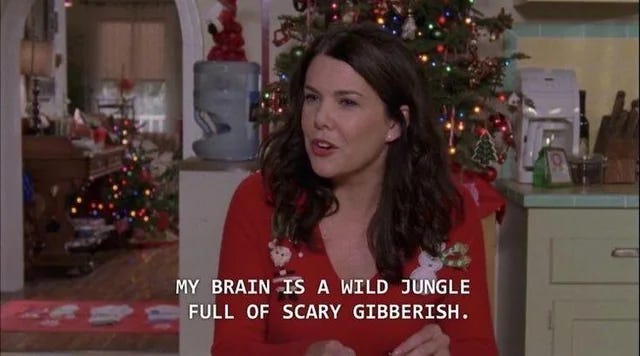
on some level i’m sure this piece of dialogue was just meant to be another humorous bit from lorelai, but the fact that the letter in question was a character recommendation for luke’s custody battle, (a task that requires significant mental energy) and that after reconnecting with very emotional memories of luke’s significant part in rory’s life, she is finally able to write the letter in a single sitting [classic hyperfocus once the seratonin is brought to the table]—i mean, the writing is on the wall.
i remember the first time i watched this episode and how utterly floored i was by how accurately lorelai had described what it felt like to live inside my head and yet somehow still, it took me five more years to get the adhd diagnosis that made so much of my childhood finally make sense.
the first time i shared the diagnosis with some of my childhood friends—the people who had known me for twenty years by that point, the longest to know me beyond my own family, and who, unwittingly informed how i thought of myself in those early years—i remember staring at a series of stunningly similar expressions of it-all-makes-sense-now with a side of absolute and utter guilt. these friends, who i do not blame in the slightest because they were operating on the information they had at the time, were coming to the realization that the one reason for all the of behaviours that they thought were simply innate to me as a person or something i was intentionally performing, was actually my brain working in a disregulated manner that was partly out-of-my-control.
now i’m not saying that i don’t have any control over my actions or behaviours, or that all people with adhd are absolved of any shitty or awful things that they do. however, i do want you to consider what it does to a person, a child, when you attribute their involuntary and compulsive behaviours as some sort of proof of their innate failings. if someone has a physical condition where their eye will not stop twitching, we do not attribute that to be their fault, and yet when it comes to mental behaviours we struggle to parse the difference.
since as far back as i can remember i have been called a thousand names—a chatterbox, incessantly disruptive, chaotic, scattered, forgetful, flippant, disorganized, impulsive, chronically late, unbelievably clumsy, and my favourite of all—absolutely annoying. most vividly, i remember my fourth grade teacher who taped a piece of paper to my desk and told me to write down my thoughts when the urge hit me to speak out of turn. naturally, i was shocked, especially when i realized she had singled me out among my peers. i hadn’t intended to disrupt the class, i hadn’t even realized i was being disruptive. but to this day i remember bowing my head in shame and internalizing that feeling under the gaze of my classmates who were unsurprised that i was yet again being disciplined.
by the time i was thirteen and in my last year of elementary school i had begun to believe that all the things my friends, peers, family, and teachers said about me were true. i was loud and annoying, i was chatty, flippant, and ditzy—i was a joke. and so, i became one. in the face of being told who i was when i knew deep down that none of these things were traits as much as they were involuntary, compulsive behaviours, i began to inhabit the persona they had given me. i became more disruptive, i pretended that i was intentionally losing things or being disorganized because i didn’t care. i relished in being kicked out of class for being disruptive so that i could wile away the period in the hallway on my own, no longer needing to perform my nonchalance in the face of everyone’s judgement and estimation of me. and by the time high school rolled around, i used my new surroundings and newfound anonymity amongst the larger student body to “mask”2 the more overt symptoms of my adhd.
after my diagnosis nearly twelve years later i was so deeply confused as to why—during the many years of my childhood being disruptive, hyperactive, and distracted, perhaps the most textbook case of traditional adhd—no one had ever suggested to my parents or even suspected on some level that i had the disorder. these days it’s a well known fact that boys are more than twice as likely to be diagnosed with adhd than girls.3 if you watch tv shows from the early 2000s you’ll notice common storylines of restless, hyperactive boys who give their parents unending headaches.4 “Many people and even professionals, whether they’re teachers or mental health providers, still think of ADHD as a “hyperactive boys’ disorder.””5 i certainly believed the same until i was an adult reading the author’s note of Helen Hoang’s The Kiss Quotient (which features an autistic female lead falling in love while dealing with realities of her neurodivergence) where the author described her own experience getting diagnosed with autism which came about much later in life only after her child was diagnosed first. similar to these “high-functioning” autism diagnoses late in life, many women with adhd are diagnosed in their thirties after their children are diagnosed first.6 not only this, the way that young girls manifest their adhd symptoms is often different from boys. although in my case my adhd was the very textbook “hyperactive” subtype (and later “combined” subtype), many girls often have the “inattentive” subtype—which results in more quietly distracted behaviour. regardless of this, girls are also known to internalize their adhd symptoms more than boys. girls will often blame themselves for being unable to complete the tasks that others are able to do with ease whereas boys, when faced with challenges, are more apt to act out and draw attention to their behaviour. when boys are overly talkative they may draw attention from their teachers but when girls are talkative they are labelled “chatty” and the behaviour is explained away as innate to girlhood. it is no wonder then that girls and women with adhd are more likely to have other mental health disorders like anxiety and depression, and ultimately suffer from lower self-esteem.
now remember lorelai? lorelai, who as a teenager was known to act out and get into trouble and who ultimately found herself pregnant and the object of all of her parents’ (increased) disappointment? lorelai, who seems to thrive through chaos and seamlessly manage an inn, but who frustratingly self-sabotages when things are going well? lorelai, who is easily triggered into emotional meltdowns and prone to disastrous reactions when people let her down?
one very fun (and by fun i mean absolutely not fun) symptom of adhd is emotional dysregulation: “Due to differences in brain areas responsible for regulating emotional responses, people with ADHD do not have the same level of control over emotions as a neurotypical person. This leads to more intense emotions in some cases and less emotions in other cases.” all of lorelai’s dramatic, emotional outbursts in reaction to her mother’s seemingly innocuous (and in some cases deliberately petty) comments, or in response to some of rory’s very well-meaning attempts to patch things up between lorelai and her parents—ultimately felt as familiar as a pair of old jeans to me.
now while people with adhd may seemingly thrive in chaotic or stressful times, they are also apt to repeatedly meltdown when things are going well. colour me (not) surprised then when seeing lorelai in season 2, on the cusp of happiness, suddenly begin to act self-absorbed, panic about moving in with her fiancé, call her ex during her bachelorette, and ultimately run away before her wedding—i felt in some ways absolutely called out.
that rainy september in british columbia when i called a cab to take me to the airport and back to the graveyard of my dreams, i knew deep down i was throwing away the opportunity that i had, up until that point, worked so hard for—and which my younger self would have killed for—and yet somehow, i finally felt secure. my anxiety was vanishing. i was finally returning to the comforting familiarity of my self-perceived inadequacy.
even now, several years later, i look back on that time7 and feel a sense of grief for what life could’ve been had i, like other neurotypical people, been able to regulate my emotions, and had i, like rory, grown up with the belief that i was innately smart and clever and capable of doing anything.
when the overwhelming narrative is that you screwed up, it takes a lot to make yourself believe that you’re not going to make a mess of things this time.
for all her failings and inadequacies, all her stubbornness and self-absorption, lorelai is still extremely clever, hard-working, and determined. like many people with adhd, the symptoms that she exhibits are also superpowers in their own right. she is quick-witted, a great storyteller, and the funniest character on the show. she is a problem-solver, a graceful multi-tasker, and she strives for her career goals with a focused perseverance that only comes with a true love for what you do.
but above all, lorelai is kind and compassionate, and if she existed in real life, she’d be the first person i’d want in my corner. she remains the one character in media that made me finally feel normal and i will always be grateful for that.
i shall not begin the laundry list here but i think the most regular critique of rory is fact that at every turn she failed to take responsibility for her actions and often pretended to be apart from the privilege she no doubt possessed
“Masking is a survival mechanism that is often developed during childhood when someone does not feel safe to express their true self…Over time those grown-up children learn to adapt to their environment and internalize the need to hide their true selves to fit in, resulting in masking becoming a habitual and automatic response. Masking requires individuals to monitor and regulate their behaviour constantly, which can be mentally and emotionally taxing. Masking causes people to […] present a persona that fits in with societal expectations, which can make it difficult to connect with others authentically.”
“Among children, boys are more than twice as likely to have an ADHD diagnosis as girls (12.1% of boys have ADHD versus 5.5% of girls). The gender gap narrows a bit in adulthood, when 5.4% of men are diagnosed with ADHD versus 3.2% of women.” https://www.webmd.com/add-adhd/adult-adhd-facts-statistics
My favourite among these is of course from Desperate Housewives where we see Lynette, who is exhausted from years of being a stay-at-home mom to her hyper and naughty twin boys, floored by her sons’ diagnosis and feels that medicating them would take away everything that makes them who they are. This is not to say medication is always the way to go for everyone with adhd but it’s interesting to see that even in this case, the behaviours are believed to be personality traits. Of course, this entire plot point was also a prelude to Lynette abusing her sons’ adderall prescription to essentially become supermom but that’s a whole other discussion about the sensationalization of adderall and other adhd stimulant medications and why to this day i am treating like a shady druggie whenever i pick up my meds from the pharmacist.
https://www.talkwithfrida.com/learn/women-underdiagnosed-adhd/
https://www.webmd.com/add-adhd/adult-adhd-facts-statistics
an episode in my life which my family has never let me forget (the amount of times i’ve heard “she packed her things up before we could get home and call her”)
Comments